

Solaris projects potential beautiful souls through the body as a medium to transmit “love” into space, thereby forming a collection of spatial stories that share a similar gravitational field. Each space may exist independently, yet may also occasionally influence another independent space at some future moment.
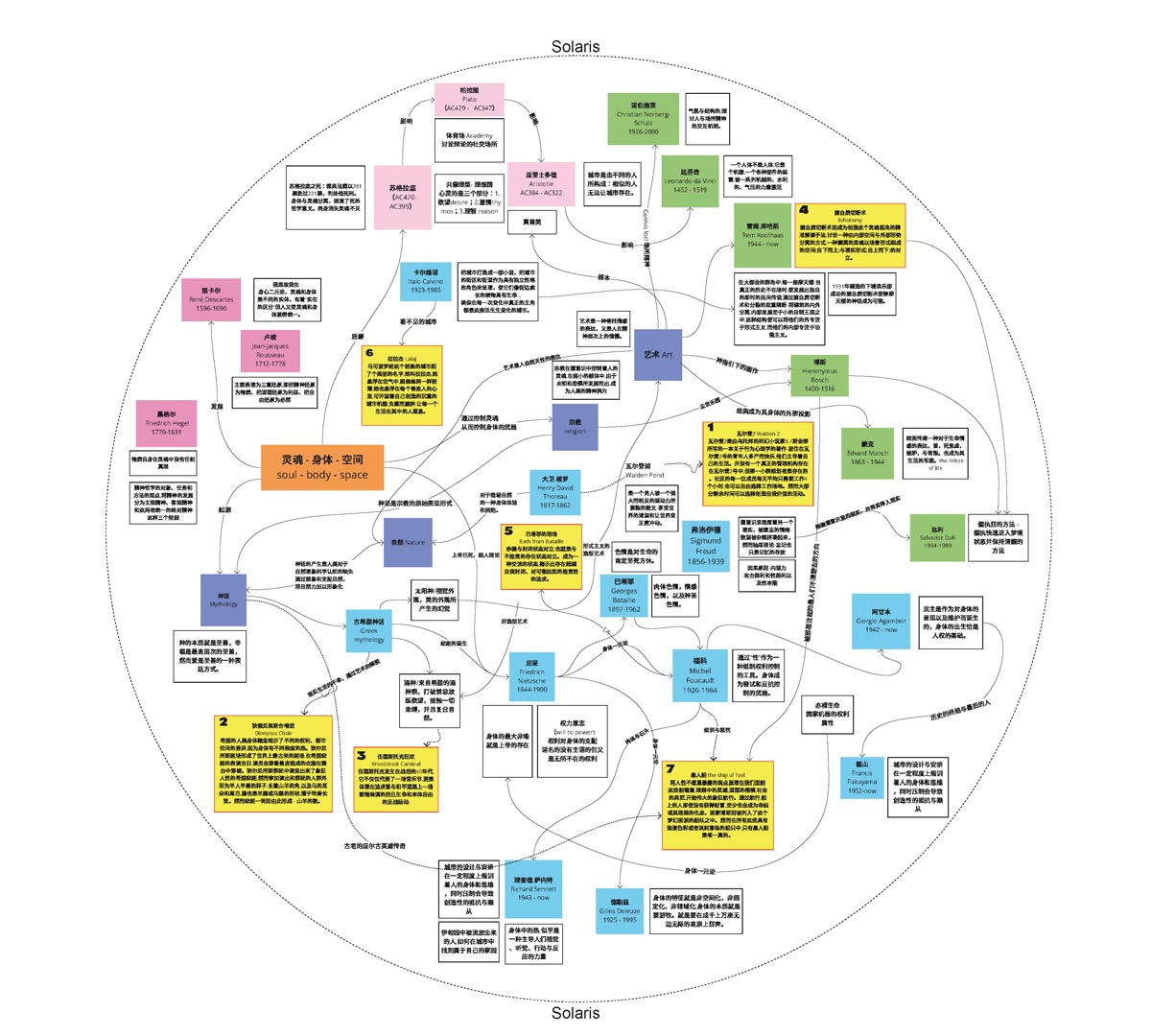
The logical thinking of genealogy, replacing the linear theory of traditional chronology, deduces the evolving relationships among soul, body, and space. It acknowledges the contingency of their connections, allowing for a more systematic understanding of how these three elements are generated under the impact of different era-specific ideas. Each event encapsulates the scene of its occurrence, relatively non-accidental, serving as a summation of past experience while simultaneously becoming the condition for unfolding in future time and space. The powerful magnetic field they collectively form constitutes the immense Solaris. It possesses sufficient energy to explore the future possibilities of space, but more conditions stem from the pursuit of truth, goodness, and beauty reflected in the soul. Through the body as a medium, transmitting “love” influences space and the unfolding of stories. The body becomes the ultimate mediator between the spiritual world and the real world.
1. Walden 2.0
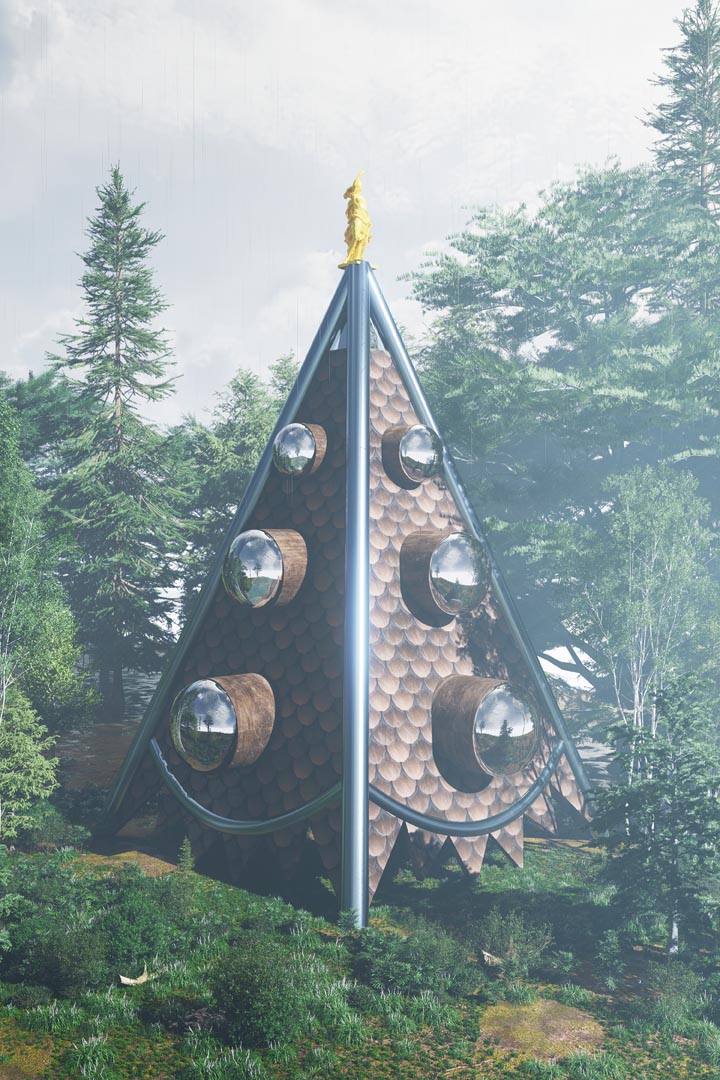
The young people living in Walden 2.0 are prolific and happy, directing their own lives. There is no true governing body within Walden 2.0, yet that small group of planners exists. Each community member needs to work only an average of four hours per day and can freely choose their workplace. Most remaining time can be devoted to activities that create self-value. There is no monetary system within the community, only a simple credit system that members can use to purchase more leisure time for cultivating personal artistic creation. Hidden in the forest, the community strips away all possible political systems, floating freely within nature. However, Walden 2.0 also mirrors the poet Thoreau’s solitary journey of projecting himself into the woods, experiencing a simple, secluded life, writing his own desires, disappointments, losses, and self-adjustments as part of living. Bathing in the shade of spring, as the lake ice begins to thaw, immersed in an absurd space created by nature—it might be nomadic, replicable, or an even more detached spirit outside the door, gulping down the air of freedom in great breaths.
2. Dionysus Choir
In The Birth of Tragedy, the sun god symbolizes visual arts leaning towards expressionism, while the wine god symbolizes the intangible inner melody. “Dionysian intoxication” and “Apollonian dream” describe the Dionysian and Apollonian states, respectively. The Apollonian produces a beauty of form, restraint, symmetry, analysis and discrimination of existence, symbolizing formalism, classicism, and visual arts. Dionysian spirit originates from the ancient Greek Dionysian rites. During these rites, people broke taboos, indulged desires, cast off all restraints, and returned to primitive nature. This is an irrational state interwoven with pain and ecstasy. “The Dionysian rapture, with its annihilation of the ordinary bounds and limits of existence, contains, while it lasts, a lethargic element in which all personal experiences of the past become immersed.” Both Dionysian and Apollonian are descriptions of artistic states and of the internal and external. The Theatre of Dionysus formed the world’s oldest theatre. On the day of a Greek tragedy performance, actors would wear costumes made of animal skins moving across the stage. The Dionysian rites gave rise to Greek tragedy, symbolizing humanity. However, participants in the rites and performances had the appearance of half-human, half-beast creatures, with goats’ horns, horses’ ears and tails, and legs shaped like goats’ or horses’ legs, skilled in playing the flute. Thus the word “tragedy” was formed—”goat song” (tragos + ōidē = tragedy).
3. Woodstock Carnival
Woodstock occurred in the post-war 1960s. It represents not just a music festival but a cathartic return to life and ontological freedom on the path pursuing love and peace, an anti-war movement. War and slaughter are means of bodily absence and re-imagination of space. However, the music festival gave the body a new spatial repose and a home for the soul. It allowed all bodies that love freedom to rediscover their own souls once more. The festival was like a seed saving souls; its entire life force blossomed completely through this seed, dispelling all gloom. In extreme frenzy, a sea of love surged disorderly across the cow field. When the rights of the body are purely returned to the self, it becomes a “bare life” with rights.
4. Lobotomy
In the constructed city, external space is segmented by the grid of capital. Lobotomy becomes the precise interpretive method for creating this island of souls, discussing a method of separating internal space from external form—a space composed of scenes formed by detached souls (bottom-up) versus a reality formed by structure (top-down). Every solitary soul seeks its own corner, like the naked boxer eating raw oysters in the downtown club, their laughter filling the space as if mocking those bodies bound by the grid. “In the archipelago of the metropolis, each skyscraper—when true history is absent—develops its own immediate folklore. Through the double severance of lobotomy and schism—separating the interior from the exterior of architecture—the interior develops into a small autonomous kingdom, allowing the structure to focus its exterior on formalism and its interior on functionalism.”
5. Bathhouse from Bataille
The bathhouse becomes a field that stimulates human instincts. The space is filled with sex and death, unleashing more bodily potential. Perhaps only through physical participation can one truly experience its temptation; the search for a companion is full of chance. However, this resonates with early Roman bathhouses. Lofty bathhouses served as spaces for catharsis and expressing viewpoints. As Sennett described, when citizens shed clothing—the disguise of social spatial roles—they could better express their human side. In the space of loving and being loved, we can recover what is lost in real life, returning to the most authentic inner self. Putting clothes back on signifies returning to traditional reality, forming hermetic bodily control. In Bataille’s description—nakedness opposes the state of enclosure, that is, opposes discontinuous existence. It becomes a state of communication, revealing a pursuit of existence beyond self-enclosure, towards attainable continuity.
6. LalaJ
Marco Polo gave this light city a beautiful name: LalaJ. She floats in the air, as thin as a spider’s web. She also floats in the hearts of every kind person. The Khan gazed upon the heavy urban machine he had created, burdensome and bloated, suffocating everyone living within it. Yet when LalaJ first appeared in his dreams, he became more intoxicated in the dream, finding the beautiful world he truly wanted to live in—a floating island, exquisitely transparent and natural, where every plant might possess its own name.
7. Ship of Fool
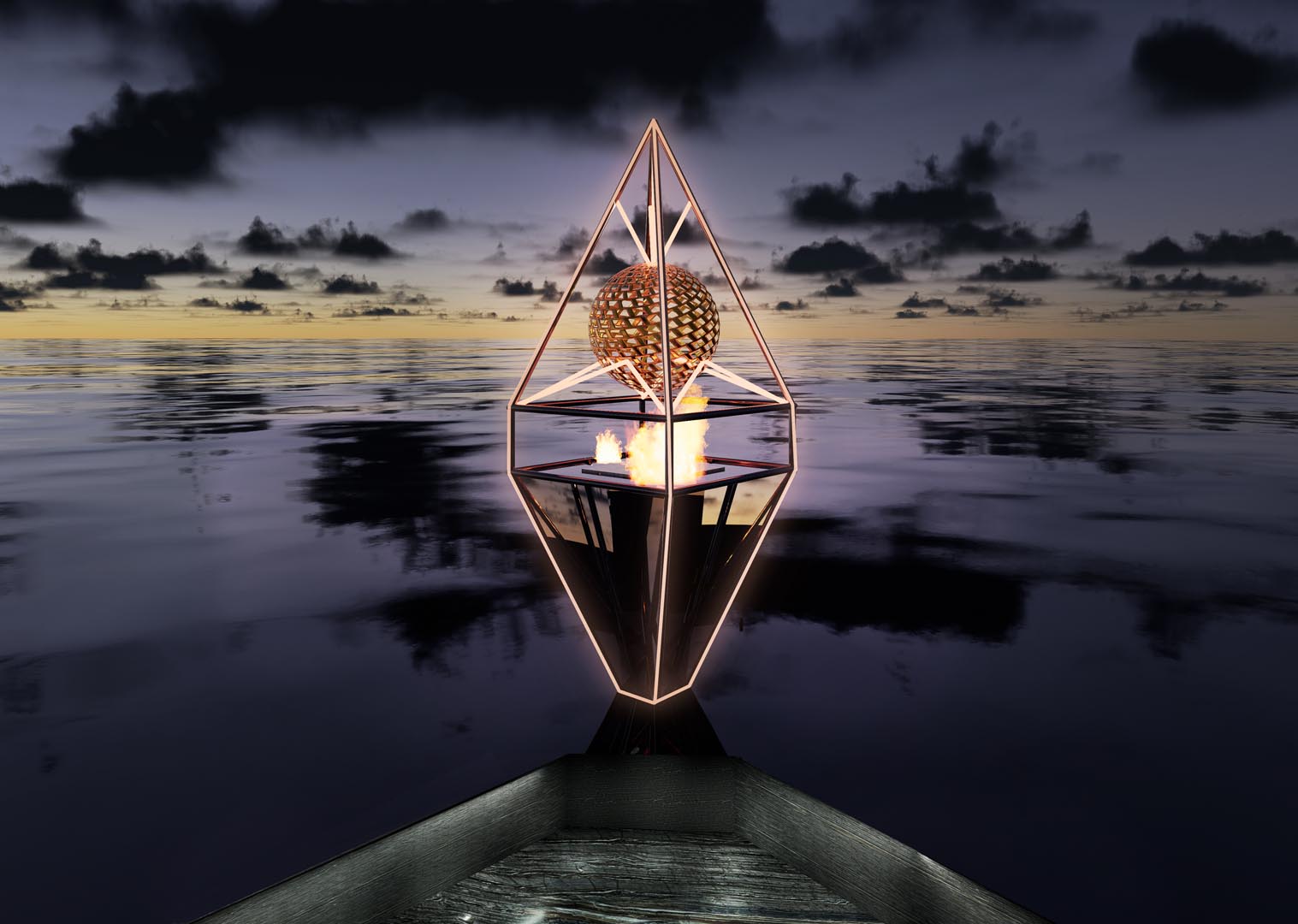
The Ship of Fool originates from the heroic legends of Yawl in Güllen. These ships carry the idealized heroes, moral paragons, and social exemplars, embarking on great symbolic voyages. Through the voyage, those on board, even if they do not gain wealth, at least become the embodiment of fate or their ideals. The painter Bosch was enlisted into the fleet of this fantastical painting school. Yet among all these vessels with romantic or satirical connotations, only the Ship of Fool is truly real, for they indeed existed historically. The Ship of Fool carried mentally disturbed passengers from one town to another. These so-called “madmen” lived relaxed and carefree lives. The wandering madmen, the act of expelling them, and their displacement did not fully signify their social utility or social security. The large-scale removal of madmen became a ritual of exile. A large group of interesting souls was confined on an airtight island, left to fate; each voyage could very well be the last. But those madmen were not necessarily the shackles of society; rather, the rule-makers might be the true fools.
Solaris is fascinating. It continuously grows within the space of love and triggers even more moving stories.